ISO Consultants for UAE Businesses: A Practical Guide
Wiki Article
The Reasons Uae Businesses Are In A Rush To Get Iso Certified In 2026
If you enter every procurement discussion in the UAE this moment and ISO certification is mentioned within the first few minutes. What used to be an optional credential for larger corporations has evolved into a essential requirement in construction, logistics, healthcare, food production, and technology. The pace of local businesses pursuing certification has picked up dramatically over the past few years.Government contracts are driving much of the demand
A large proportion of current flurry of activity comes directly from semi-government or government tendering requirements. The majority of contracts for public sector work across the Emirates will now include an ISO certification as a compulsory prequalification document rather than an optional addition, which implies that firms without one are basically excluded from tendering before price or capacity even enter the conversation.
International Trade Partners Expect It as Standard
The UAE's role as a regional trade and logistics hub means a significant proportion that local businesses do business with international partners, and those businesses increasingly look at ISO certification as a primary credential rather than a distinct feature. An European or North American buyer evaluating a company based in the UAE will typically choose due to the fact that the recognised management system certification is in place, as it's a familiar source of information regardless of how well they know the local market.
Free Zones Are Actively Encouraging certification
A few of the biggest UAE free zones have been pushing certification support as part of their business set-up packages which recognizes that tenants with a certification tend to be more attractive to clients and expand more efficiently. This encouragement of the institutional level, combined with real competitive pressure has pushed certification from an issue of specialized considerations to something closer to standard business hygiene.
The Risk and Insurance Considerations Are Making an appearance in the market.
Insurers operating in UAE market have been increasingly including management system certification in their risk assessments, particularly in sectors such as manufacturing and construction, in which quality and safety issues carry significant liability exposure. A certified quality or safety management system provides insurers with an evidence-based basis for the pricing of risk. A few are now offering better rates to those with certifications due to this.
The Cost of Certifications Has Reduced
Competition among certification bodies and consultants working in the UAE has reduced prices dramatically compared to 10 years earlier, making certification available to smaller and medium-sized businesses that had thought it was just for large corporates. This reduction in costs opens the door for a wider array of firms seeking certification first time.
Different Standards Suit Different Businesses
There are many businesses that require the same certification and figuring out which one really is the most difficult thing to figure out. Construction companies' priorities in safety management may differ to a software firm's requirements with regards to security and information. This can be the reason that demand has grown across a broad range of standards rather than concentrating on only one.
What does this mean for companies? Are they still on the fence?
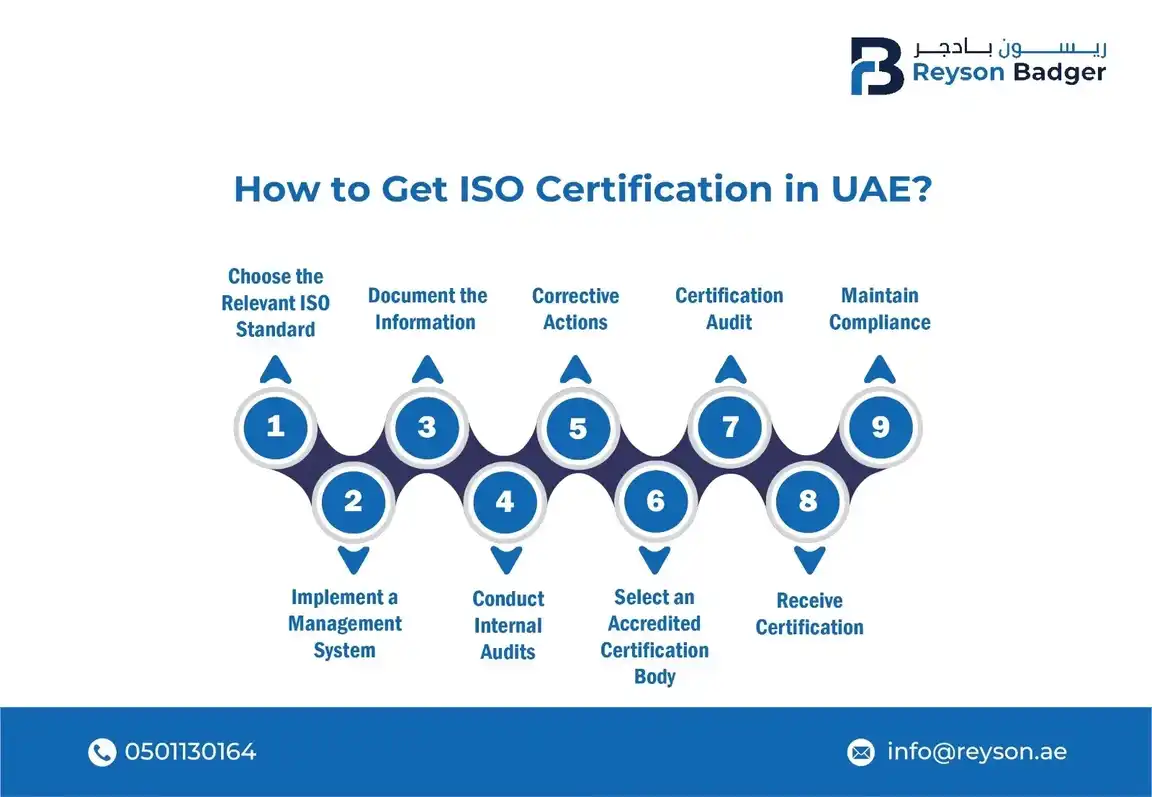
For those companies that are still contemplating whether certification is worth considering, the practical reality in 2026 is that it shifts from whether competition have certification to how many possible opportunities are going unnoticed without certification. The typical process begins by conducting a gap study against the applicable standard, that is followed by an organized execution period prior to a formal external audit, and the whole process is considerably more straightforward than even five years ago.
The Talent Market Doesn't Have the Right Response
Certification has become central to how UAE businesses function, the market for local talent is developing around quality environmental and safety management role, with a greater number of professionals that have been recognized as lead auditors and accreditations in implementation than at any time before. This has made it significantly easy for businesses to recruit internal staff who are capable of maintaining a their management systems long following the certification project closes, rather than using external consultants indefinitely.
Multinational Companies Set the Regional Tone
Many multinational companies that have through regional or Middle East headquarters out of the UAE take their global standard requirements for certification to their local counterparts, which requires local suppliers as well as partners to follow the same standards. It has had a clear impact on local businesses supplying into these supply chains for multinationals frequently see certification requirements flowing down from expectations of the client that came from far outside of the UAE itself.
Certification is increasingly viewed as a Growth Enabler, More than Compliance
Perhaps the most important shift in thinking over the past few years is the fact that more UAE businesses now view certification as something that actively enhances growth, by opening opportunities for tender eligibility as well as international partnership opportunities instead of simply a defensive cost for compliance. This reframes the expense much more easily to justify internally because it connects directly to revenue opportunities, rather than being just a part the compliance budget.
What to Expect in the Years ahead
Based on the current trajectory and the current trends, it's reasonable to think that ISO certification will keep moving away from a competitive benefit to a complete demand for market entry across an increasing variety of UAE industries over the next years. Businesses that have a head start on this shift now, rather than waiting for certification to become mandatory usually find the process considerably more calming and the standing in the market is far more solid.
How Long the Whole Process generally takes
The full journey beginning with the gap assessment and ending with the time of certificate issuance can range between three and nine months depending on business size and maturity of the process, and the speed with which internal teams can implement needed adjustments. Companies under a lot of pressure tend to try to reduce this timeline, but speeding up the process to implement can produce a process that does not perform well at the first examination, making an accurate timeframe a real investment.
In the end, the rise in ISO certification across the UAE indicates a market has matured past treating security and quality management as a preference of the internal staff and has begun to consider it an essential aspect of doing business with a serious attitude, both locally and internationally. In the case of any business wishing to begin, the first procedure is to engage in a short, candid conversation with an approved certification agency or an experienced consultant about which ISO standard matches current processes and customer expectations, rather than merely guessing the competition's standards based on what displays on their website. None of this momentum shows any signs of slowing this makes the present situation a sensible one for companies still contemplating certification to move from consideration to move to. Read the recommended ISO 20000 Certification for website recommendations.
ISO 9001 Explained: Quality Management for UAE Businesses
ISO 9001 remains the most commonly used management system throughout the world and with good reason. It is based on a practical concept that a consistent quality comes from consistent, efficiently managed processes rather that good intentions on their own. For UAE businesses considering certification, understanding what the standard actually demands can help to simplify the procedure, which is often more complicated than it is.What ISO 9001 Is Actually built around
In essence, ISO 9001 asks a business to identify its primary processes, understand how they interact and evaluate whether they're performing, and adjust them regularly as time passes. Instead of setting out the specific ways the business should be run and run its operations, ISO 9001 provides a framework to ensure that the approach a business takes is consistent, documented when necessary, and is actually followed.
The reason UAE Businesses Pursue It
Beyond the goodwill associated with Certification, a large number of UAE businesses pursue ISO 9001 because government and tenders from the private sector increasingly mention it as an eligibility requirement for prequalification. Beyond that when they implement it, companies that do ISO 9001 in the right manner can enjoy real operating benefits, including less repeated mistakes, clearer accountability and a better approach to handling customer complaints.
The role of top Management
One area the standard is extremely clear on is real participation of the leadership team, instead of the quality management system being delegated to the compliance manager, which is completely detached from the actual decisions. Auditors look for evidence that top leadership is aware and actively support the quality management system, instead of merely signing off on it.
The importance of Risk-Based Thinking is a central part of the Modern Standard
The latest version ISO 9001 places considerable emphasis on identifying the risks and opportunities relevant to a business's specific context, and not relying on an all-encompassing checklist irrespective of circumstances. This means that a UAE construction company and an UAE software firm, while both certified to the same standard but will come up with significantly different quality management processes showing their distinct risk profile.
Customer Focus is a constant throughout the Standard
ISO 9001 repeatedly returns to the notion that quality implies meeting the needs of customers and expectations, not just internal efficiency indicators. Companies that adopt the standard are expected to employ genuine processes to know what customers require and ensuring that they are happy, rather than believing that internal quality tests alone can provide the whole picture.
Its Certification Process Itself
After implementing the appropriate processes and documents, certification involves an external auditor who performs two stages. The first is reviewing the documentation and readiness before checking if the system is truly operating as stated. The certification process is followed by annual surveillance audits and a full recertification audit roughly every three years to ensure continuing compliance.
Common Misconceptions Worth Clearing
The most common misconception is that ISO 9001 requires enormous volumes of paperwork. In reality, the actual version has reduced the necessity of documentation by a significant amount compared to previous versions, instead focusing on demonstrating that the process is being controlled. Another misunderstanding is that certifications guarantee product quality directly, when it actually proves that businesses have a consistent method of managing quality, that's a significantly different but still important.
How Differently It is Applied Across Different Sectors
A construction company implementing ISO 9001 will focus heavily on the handover process and subcontractor management. While a professional services company might concentrate heavily on client interaction processes or knowledge-management. The standards' real flexibility across all sectors is why it's still relevant in such a broad array of UAE industries in all aspects, from manufacturing to consulting and retail.
The Role of Continuous Improvement
ISO 9001 doesn't treat quality as a status quo, but as an ongoing cycle of evaluating results, identifying ways to improve, and then implementing changes systematically. Businesses that are truly committed to this continual improvement mindset, rather than considering certification as a one-time project, will reap the greatest long-term operating benefits from ISO 9001.
How to Prepare Your Team to handle the Cultural Shift
Perhaps the least understood aspect from ISO 9001 implementation is the actual change in culture that's required, changing from individual-driven, informal ways of working toward more structured, consistent procedures that do not rely on a single person's memory or judgement. Preparing staff for this shift and educating them on the real benefits rather than presenting it just as a compliance test significantly improves the way execution goes.
Why the Investment Tends to pay off
Organizations that implement ISO 9001 thoughtfully, rather being viewed as an administrative exercise to meet the external requirements, typically get the return on investment by fewer mistakes, greater internal accountability and a solid foundation to scale operations as the growing business grows. The benefits exceed the scope of the certification its own.
Which Ways ISO 9001 Interacts With Customer Complaints Specifically
The Standard requires businesses to possess a thorough, structured process for handling complaints from customers and feedback. They must treat each complaint as a data point that must be fed back into improving the efficiency of the process rather than being dismissed and not being remembered. UAE companies that establish this feedback loop well often will find that it is one of the most practical components of their management system far beyond its function in completing the audit.
For UAE businesses who are considering whether ISO 9001 is worth pursuing In the end, it all boils down to if the business truly desires more efficient, consistent processes. since the certification is an official recognition of that underlying operational discipline. For UAE enterprises that are genuinely interested in improving their operations instead of simply getting the certificate, ISO 9001 offers a validated, internationally recognised process for making the change continuous, not accidental. None of this requires abandoning the practices that are already working well within a company, since ISO 9001 is fundamentally about formalising and strengthening good practice instead of replacing it with something entirely unfamiliar. When approached this way, certification becomes an integral part of good management rather than as a burden that is externally placed on the company. It is, at the end of the day it is a system built around general sense and a consistent application rather than something that is a mystery. That, more than anything else is what makes it worth being considered with seriousness. Few other investments have such the broad and long-lasting benefits of operation. Incredibly worth the effort it takes to master. Take a look at the best ISO 45001 Certification for blog tips.
